
Automobile retail sales in the country fell 18 per cent year-on-year in the 42-day long festive period this year as semiconductor shortage impacted production across companies affecting their ability to supply adequate numbers to dealer partners, FADA said on Thursday. During the period under review, barring three-wheeler and commercial vehicles, all other segments including passenger vehicles, two-wheelers and tractors were down as compared with the same period of last year. As per data collated by the Federation of Automobile Dealers Associations (FADA), total retail sales across segments stood at 20,90,893 units this festive period, down 18 per cent from 25,56,335 units in 2020.

At the end of May, out of 26,500 outlets about 60 per cent showrooms and 80 per cent workshops were operational across the country.

After a very weak December quarter and a poor year-to-date fiscal year volumes-when sales plunged to the lowest in nine years, the signs in the first 15 days of January haven't been encouraging either. "Though the severity of the current wave is not as high as the previous one, it has hit the sentiments hard impacting conversion of enquiries into sales," said Vinkesh Gulati, president, Federation of Automobile Dealers Association (FADA).

Open order books in February breach 700,000; wait period for some models exceed a year.
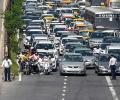
The lockdown in Maharashtra will have a catastrophic impact on April sales, as dealers will not be able to realise the potential of festivities like Ugadi, Gudi Padwa, Baisakhi and Poila Boishakh.

During the meeting with Finance Minister Nirmala Sitharaman, the auto industry broadly presented factors such as issues regarding availability and affordability of financing, increasing cost of acquisition of vehicles and change in axle load capacity for commercial vehicles that have hurt demand.

As macroeconomic numbers continue to disappoint, reaching pre-Covid level is unlikely in FY21.

At Prestige Polygon Towers in Chennai's Teynampet, hectic preparations are on for a mega global investors' meet under the aegis of Guidance Tamil Nadu (the state investment promotion agency) scheduled for January 2024. Asked about the key focus areas of the meet, the agency's managing director and chief executive officer, V Vishnu, said the state was betting big on electric mobility. This is no surprise, given that the state has signed electric vehicle (EV)-related memorandums of understanding (MoUs) with several companies in the recent past that may bring in investments worth around Rs 33,000 crore with the potential to create over 43,000 job opportunities.

Consumer goods firms and auto companies are witnessing an upturn in rural demand, which had been lagging for most of FY24. Expectations of a bumper rabi crop harvest have helped turn the tide. The Reserve Bank of India's (RBI's) Monetary Policy Committee kept the repo rate unchanged last week, noting that as rural demand catches up, consumption is expected to support economic growth in 2024-25.

Analysts have predicted a 23 per cent volume growth for the auto segment between FY22 and FY25, riding on the company's differentiated EV and SUV plan. M&M is already a market leader with a 36 per cent share in electric three-wheelers, and its Zaheerabad plant in Telangana is ready to cater to demand. In the farm segment, the company plans to focus on niche electric products.

Market leaders Maruti Suzuki and Hyundai, who together control two-thirds of the domestic market, have not yet firmed up a decision on raising prices.

After incurring losses for two years on the trot, German luxury automotive company Bayerische Motoren Werke AG (abbreviated as BMW) has posted net profit in India in 2021-22 (FY22), primarily due to high demand of its top-end vehicles, cost optimisation, and price hikes, Business Standard has learnt. BMW India said in its FY22 financial statement that the company is focusing on growth and achieving profitability through induction of new products in the market, strengthening its dealership network, and improving customer satisfaction while reducing costs. The company posted its highest-ever revenue in India in FY22 at Rs 4,365.8 crore.

Earlier in May, Ford India announced that it had dropped its plans to make electric vehicles (EVs) in India, which it intended to export, under the production-linked incentive scheme (PLI). Ford was among 20 companies that had signed a Champion OEM Incentive Scheme under the PLI project with the government in February this year. The decision comes as a blow for the 4,000-odd employees at Ford India's Maraimalai Nagar plant near Chennai and in Sanand, Gujarat. In September last year, the company had announced that it would exit the India market, which it had entered in 1995 through an on-again, off-again joint venture with Mahindra & Mahindra (they split in 1998, signed a JV in 2019 and split again in December 2020), retailing petrol and diesel brands such as the EcoSport, Figo, Aspire, and Endeavour.
For automakers, the festive season is about raking it in through ramped up sales and attractive consumer offers. However, despite the robust demand, what may spoil the party this year is a global shortage of semiconductors.

With car penetration of around 22 per 1,000 population, India continues to be a big opportunity to sell cars, especially in rural areas.

Among those who have the most to lose from India's haphazard policies are dealers selling cars made by Toyota, Mahindra & Mahindra, Daimler AG's and Tata Motors' luxury arm, Jaguar Land Rover

The first leg of the 35-day festive period, which ended with Dussehra, failed to bring any cheer for auto companies. While makers of passenger vehicles struggled to meet demand due to the persistent shortage of semiconductors, a recovery in demand remained elusive for two-wheeler manufacturers despite offers and schemes. The overall season, which ends two days after Diwali, is unlikely to bring any turnaround in either the supply or the demand scenario, said dealers and officials at auto companies.
Retail sales of overall vehicles in India grew by 15.28 per cent to 2,11,20,441 units in 2022 led by record sales of passenger vehicles and tractors, Federation of Automobile Dealers Associations (FADA) said on Thursday. In 2021, total retail sales of vehicles in India were at 1,83,21,760 units, FADA said in a statement. Two-wheelers retail sales stood at 1,53,88,062 units last year, a growth of 13.37 per cent from 2021 when sales stood at 1,35,73,682 units.

Large investors track high-frequency data that is immediately available today. That data has been bullish, points out Debashis Basu.

The total vehicle registrations in India fell by 29.85 per cent to 1,52,71,519 units in financial year 2020-21, the lowest in the last eight years, the Federation of Automobile Dealers Associations (FADA) said on Monday. Total vehicle registrations were at 2,17,68,502 units in fiscal year 2019-20. All categories of vehicles, except tractors were in red in FY21 with two-wheeler (2W), three-wheeler (3W), commercial vehicles (CV) and passenger vehicles (PV) falling by 31.51 per cent, 64.12 per cent, 49.05 per cent and 13.96 per cent respectively -- the lowest in last eight years and way below the FY13 levels, FADA said in a statement.

Increasing the duties on auto parts and putting an additional cess on petrol and diesel could drive up costs of vehicles, specially where volumes are low and localisation is not viable.

The first half of 2019-20 will be under pressure, since prices are expected to go up by Rs 7,000-8,000 at a time when sentiment is poor.

Recently, South Korean Foreign Minister, Chung Eui-yong, dialled his Indian counterpart, S Jaishankar, in New Delhi. His government, he said, "regretted the offence caused to the people of India". A day earlier, India had summoned the South Korean ambassador to express its "strong displeasure" over "an unacceptable social media post".
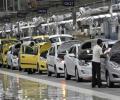
The government on Friday announced several relief measures including deferring one-time registration fee, lifting the ban on purchase of petrol/diesel vehicles by its departments and allowing higher depreciation, but it remained non-committal on the demand for a reduction in GST rates.
Indian consumers are likely to get respite from rising prices just before the festival season. Some consumer companies, including automakers, have indicated that they are planning to pause price hikes just before demand picks up in August, while keeping a close eye on volatile raw material prices.
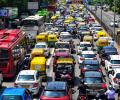
If the court order is implemented, it will lead to an increase in the insurance outgo for car owners by a minimum Rs 50,000 for car and a minimum of Rs 7,000 for two-wheeler owners.

However, the World Bank has projected India's GDP growth rate at 7.5 per cent for the next three financial years, including the current one.
'Inquiries and bookings are at quite a healthy level.'

While companies have not launched too many products in rural areas of late, easy financing has helped push up demand.

In case of exchange, the automobile company offers the wholesale price on the old car, which can be 10-12 per cent lesser than the retail price.

Durable goods companies and retailers say online sales won't compensate for the fall in offline sales.
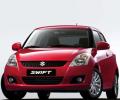
Paris-based international advisory firm Mazars predicts four per cent growth in India's automobile sector this financial year.

In May, Satpal Singh, who runs a dairy business with three buffaloes in Jewar, near Noida, was worried about the steep spike in input costs. Singh said dry fodder rates, which cost Rs 1,500-2000 per tractor trolley last year, were quoting at Rs 4,500-5,000. The price of other cattle feed ingredients (that include mustard meal and similar mixes) had also gone up from Rs 2,000 per quintal to Rs 3,100-3,200 per quintal.

Renault will start with a slew of new products that will be launched over the second half of this year and next year, apart from giving facelifts to the Kwid and Duster.

As monsoon picks up, be ready to drive through water-logged areas and mushy roads. Since motor accidents typically see a rise during rains, motor claims also move up.

The cars, some 482,000 Passats, Golfs and Jettas sold in model years 2009 to 2015 in the United States, are peppy and fun to drive, owners say.

The development comes after a recent notification from the Union home ministry, which has permitted companies to resume manufacturing operations and reopening of shops in red, green and orange zones with certain riders.

Cashi Crisis: Day 9: Aaj ki Taaza Khabar!
